
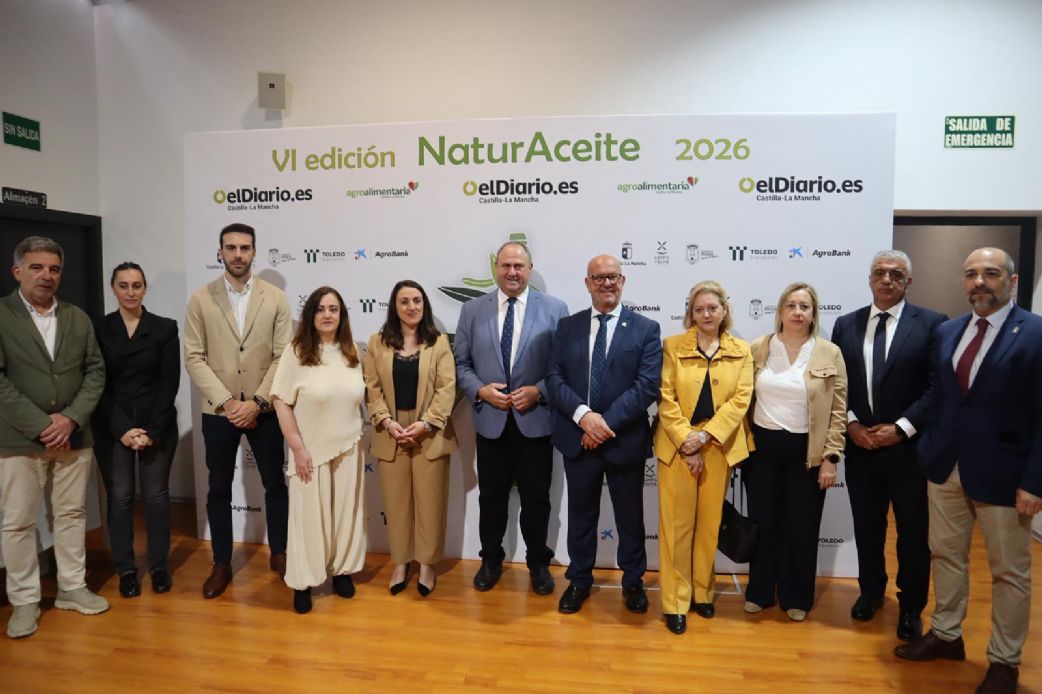
The Regional Minister of Agriculture, Livestock and Rural Development, Julián Martínez Lizán, reported that, according to end-of-campaign data (March 31), Castilla-La Mancha has produced 138,291 tonnes of olive oil.
Although this figure is slightly below last year’s production, it is 18.6% above the average production of the last ten campaigns and represents around 11% of the oil produced in Spain a share that also exceeds the decade average of 9.2% “which consolidates our position in terms of both area and production.”
Julián Martínez Lizán made these remarks in Mora, where he attended the NaturAceite Conference, an event organized by elDiario.es Castilla-La Mancha and its Agri-food section, accompanied by the Director General of Agri-food Production and Cooperatives, Elena Escobar; the Regional Delegate for Agriculture, Livestock and Rural Development, Elena Martín; the mayor of the town, Emilio Bravo; the director of AgroBank Castilla-La Mancha and Extremadura, Pedro A. Martínez; and the deputy for Environment, Livestock and Agriculture of the Provincial Council of Toledo, Marina García.
The minister explained that Castilla-La Mancha has consolidated its position as a reference region in olive oil production not only in Spain but also at European and global level, becoming the world’s third-largest producer, after Andalusia and Puglia (Italy).
The sector has a solid structure, made up of around 83,000 olive growers, 264 mills which in recent decades have made a significant leap in quality and four Protected Designations of Origin, all under the Campo y Alma quality brand, “a seal that guarantees that the products consumers purchase are of high quality.”
In addition, there are 460,000 hectares of olive groves spread across emblematic municipalities such as Mora, where “olive growing is especially important because it is a social crop, due to its job creation especially during harvest time although it also presents a challenge in terms of labour; and also because of its economic impact, as all families in Mora are in one way or another linked to this productive sector. It has also played a key role in landscape conservation.”
“Therefore,” added Julián Martínez Lizán, “events such as this conference and, above all, the Olive Tree Fair that you will celebrate this coming weekend, help highlight the importance of this crop for all of us.”
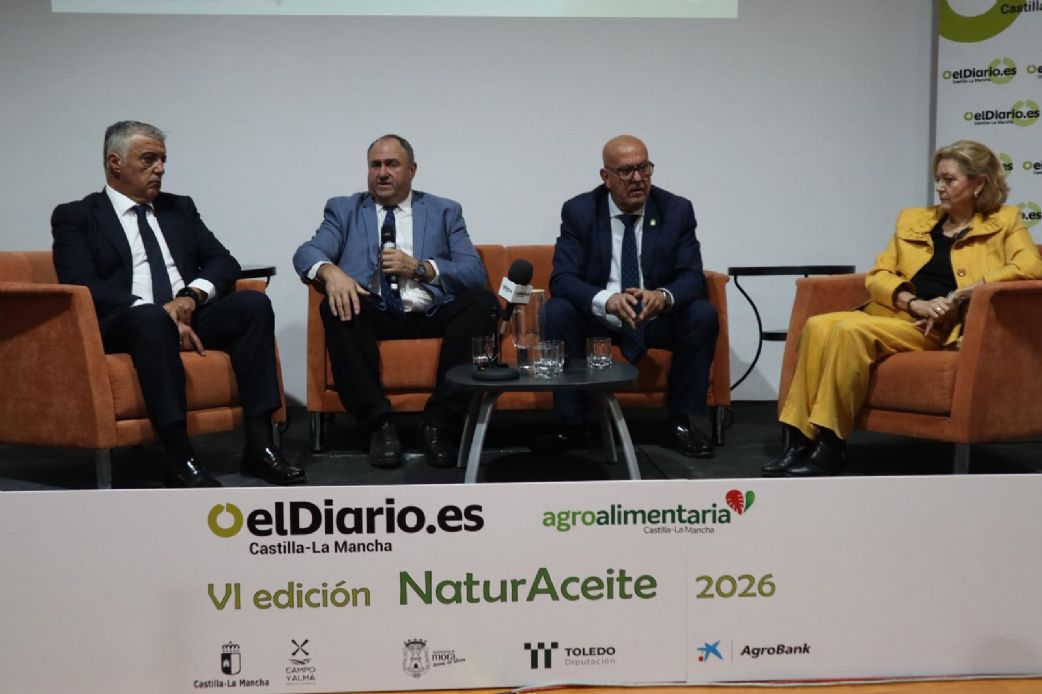
VI Edition of NaturAceite
Regarding the event, Julián Martínez Lizán stated that it has already become a “benchmark” in the olive and olive oil sector, and thanked its director, Carmen Bachiller, for always keeping the agricultural and livestock sector among her priorities, as demonstrated by the fact that this digital outlet has an exclusive section dedicated to it, such as Agroalimentaria.
He also highlighted that this year’s edition will address highly relevant topics, including agronomic issues and, above all, commercialization. In this regard, the regional government is investing €2.8 million this year in agri-food promotion, aimed at ensuring a presence at the main agri-food trade fairs, advertising campaigns, outdoor promotion in major cities, and direct-to-consumer retail points.
“We continue to believe that promotion is one of the best tools, especially in this geopolitical context that has a real impact on productive activities,” he said. Despite this, Castilla-La Mancha continues to grow in exports, which indicates that “we produce well, with quality, and we are opening up international markets.”
In this sense, the minister stated that these measures will continue to be implemented in order to achieve greater added value in production and ensure it benefits primary producers.
“Viable, as olive oil is, with sustained prices given that the average oil price has been €4.28 per litre, a figure very close to the national average and which is within a range that is already considered profitable. We hope that in the coming campaigns this trend continues and farmers can maintain profitability in their farms,” the minister concluded.
 Sentido Común Internet
 Agrifood Comunicación

 Solo disponible accediendo desde Safari
