

The Executive Director of the North American Olive Oil Association (NAOOA), Joseph R. Profaci, reviewed the evolution of the U.S. olive oil market over the past two years in his presentation “The American Olive Oil Market.” His talk was part of the conference “The Olive Oil Sector Today: Between Strategy and Operations,” organized by Grupo Interóleo, sponsored by Amenduni, Caja Rural de Jaén, Grupo Migasa, and Sanitas, and held in collaboration with the Olive Oil World Congress.
Profaci took as his starting point the November 2024 data from the USDA Economic Research Service. According to these figures, the United States consumes around 400,000 metric tons of olive oil, roughly 15% of global consumption. Over the past two decades, growth has been concentrated in virgin and extra virgin olive oils, while consumption of refined olive oil has remained practically flat.
From there, Profaci built his talk in chapters, using the language of Sergio Leone’s films as a metaphor.
In the first chapter of the “movie,” Profaci walked through the sequence of trade decisions affecting olive oil over the past year and a half. In April 2025, reciprocal tariffs under the IEEPA went into effect. In February 2026, the Supreme Court ruled that this law did not provide for the imposition of tariffs. A few days later, a temporary 10% surcharge was introduced for 150 days. In July 2026, the Office of the United States Trade Representative (USTR) announced tariffs of between 10% and 12.5% under Section 301, with no specific exemption for olive oil. As of September 18, he explained, the legal proceedings on these tariffs were still pending before the Court of International Trade and the measure remained in effect.
Against this backdrop, NAOOA is working to have olive oil included in Annex A of exempted products. In Profaci’s view, olive oil deserves treatment in line with its characteristics, as it is a healthy food that U.S. production cannot supply in sufficient quantities. The association has shared this position with the International Olive Council and has encouraged producing countries to include it in their bilateral negotiations with the United States. The speaker acknowledged that it is difficult to anticipate how long the current framework will last and advised the sector to follow its evolution closely.
Profaci devoted the second chapter of the “movie” to the relationship between food and health, an area in which, in his view, olive oil emerges stronger. He explained that the debate opened by the FDA on the definition of ultra-processed foods has placed the degree of processing at the center of the conversation. In this debate, virgin olive oil starts with an advantage, with a trans fat content equal to or below 0.1%, lower than that of other vegetable oils.
This same focus on health is reaching health care programs. In September 2026, a group of members of Congress asked the Centers for Medicare & Medicaid Services to allow Medicare Advantage plans to provide healthy food to seniors with chronic conditions. Profaci saw this as an opportunity for olive oil and presented a research partnership proposal with NourishedRx: a six-month intervention with 500 Medicare beneficiaries, following a Mediterranean diet protocol with two liters of extra virgin olive oil per person per month. The goal, he explained, is to generate evidence so that EVOO can become part of health care.
In the third chapter, Profaci described how olive oil has gained prominence in U.S. food policy. He cited the FDA’s new definition of “healthy,” adopted in December 2024, which expressly includes 100% olive oil. He also mentioned the Dietary Guidelines for Americans 2025–2030, published in January 2026, which recommend prioritizing oils with essential fatty acids, such as olive oil. To illustrate the shift, he compared the 1992 Food Guide Pyramid, which advised using fats sparingly, with the new Eat Real Food image, in which the olive oil bottle takes a prominent place. This image has also carried over into government communications and into promotional merchandise of the MAHA (Make America Healthy Again) movement.
Consumers appear to have responded. According to Google Keyword Planner data, searches for “extra virgin olive oil” reach 246,000 per month, with 22% year-over-year growth, while searches for other oils and fats are declining. It is the most-searched term among cooking oils and the only one that is growing. Behind it come “olive oil” and coconut oil, with 135,000 searches each, ghee with 110,000, and canola oil and beef tallow with 74,000. All of them show declines of between 18% and 33%. Overall, olive oil accounts for more than 40% of the oil searches analyzed.
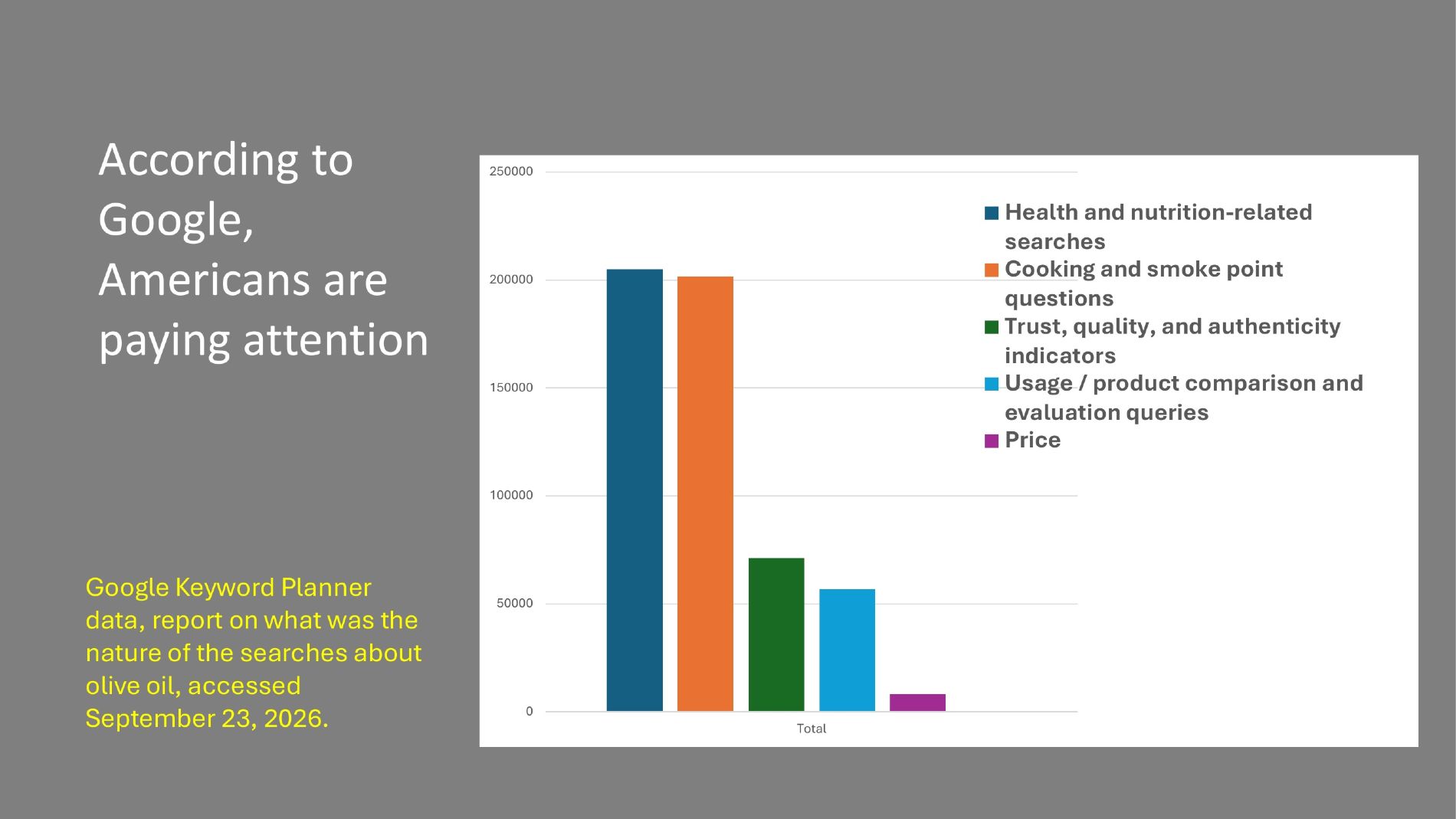
Profaci placed particular emphasis on the analysis of the reasons behind these searches, as it reveals what American consumers want to know about olive oil. Health and nutrition-related searches are the most numerous, with over 200,000. They are closely followed by queries about cooking and smoke point, also at around 200,000. Next come searches on trust, quality, and authenticity, close to 70,000, and on product comparison and evaluation, some 55,000. Price accounts for only around 1.5% of searches.
In Profaci’s view, American consumers are interested in what extra virgin olive oil brings to their health and in how to use it in the kitchen, and this is the foundation on which to keep building the product’s value in this market.
In this context, the NAOOA Executive Director noted that the organization’s petition to create an Olive Oil Board for research and promotion could move forward in 2027–2028, with an estimated budget of more than $6 million a year. In his view, olive oil’s greater prominence in food policy may also drive the establishment of a specific standard of identity for the product.
Profaci concluded that the United States remains the world’s most important market for olive oil and that the new focus on healthy eating makes that argument stronger than ever. He said that companies investing in distribution and production in the country will be the ones to benefit most from the consumption growth expected in the coming years.
 Sentido Común Internet
 Agrifood Comunicación

 Solo disponible accediendo desde Safari
