
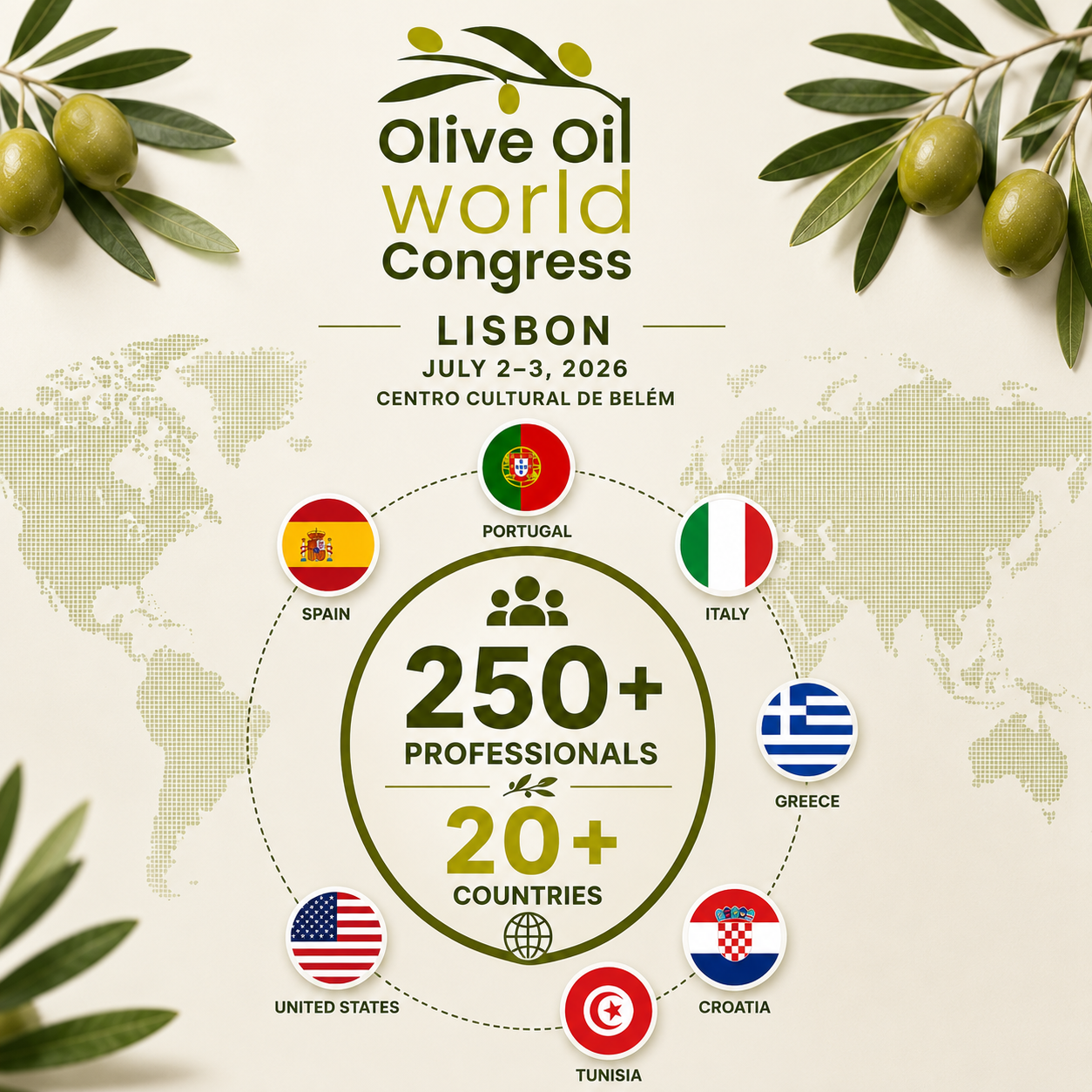
Lisbon is preparing to become the world capital of olive oil on 2 and 3 July. More than 250 professionals from over 20 countries have already registered for the Olive Oil World Congress (OOWC), an event that will bring together some of the leading experts, researchers, institutional representatives, and business leaders from the international olive oil sector.
The Congress, which will take place at the Belém Cultural Centre, comes at a decisive moment for the olive oil industry, marked by the technological transformation of olive groves, the challenges arising from climate change, growing international demand, and the increasing recognition of olive oil’s health benefits.
Over the course of two intensive days, the Portuguese capital will become the setting for discussions on the future of one of the most emblematic foods of the Mediterranean Diet.
The Congress will be officially opened by José Manuel Fernandes, Portugal’s Minister of Agriculture and Maritime Affairs, and Jaime Lillo, Executive Director of the International Olive Council (IOC), the world's leading institution for the olive oil sector.
This will be followed by a keynote address from the renowned researcher Dr Fabrice DeClerck, of EAT-Lancet, entitled “The Role of Olive Oil in Future Food Systems and Global Nutrition”.
Portugal, one of the world's leading olive oil-producing countries, will also play a particularly prominent role in this edition through the participation of distinguished national experts. These include Carla Inés, from the National Institute for Agricultural and Veterinary Research; Julián Ferrer, from De Prado; Carlos Fontão de Carvalho, from the Portuguese Academy of Gastronomy, who will analyse the influence of gastronomy and chefs on consumer purchasing decisions; Ana Carrilho, from the Lisbon School of Agronomy; José Alberto Pereira, from the Polytechnic Institute of Bragança, who will discuss the role of traditional olive groves as a source of biodiversity and ecosystem services; and Gonçalo Moreira, from Olivum, who will present the importance of achieving recognition for the olive oil sector as a sustainable industry.
The international dimension of the event will also be reflected in the participation of representatives from organisations and institutions from Spain, Portugal, Italy, Greece, Croatia, Tunisia, the United States, and several other olive oil-producing and consuming countries.
In addition, the programme will feature specialists from universities, research centres, technology companies, and international organisations, who will address key topics such as olive grove digitalisation, genetic improvement of olive varieties, efficient water management, olive oil quality and authenticity, environmental sustainability, circular economy, health, international trade, and new communication and market positioning strategies.
Alongside the scientific and technical sessions, the programme will also include a scientific poster exhibition, an international olive oil tasting featuring oils from different producing countries, and an awards gala, all of which will reinforce the global and multidisciplinary nature of a forum designed to connect the entire olive oil value chain.
With participation already exceeding 250 registered attendees and continuing to grow just weeks before the event, the Olive Oil World Congress is consolidating its position in its second edition as the leading international platform for analysing and debating how olive oil should be produced, marketed, and consumed in the coming decades.
Individuals, companies, and public or private institutions from the olive oil sector interested in participating in the Congress may register through the following link: https://www.oliveoilworldcongress.com/inscription
The Congress already enjoys the institutional support of the International Olive Council (IOC), CIHEAM Zaragoza, and the Mediterranean Diet Foundation, together with public bodies such as Portugal’s Ministry of Agriculture and Maritime Affairs, the Regional Government of Castilla-La Mancha (“Campo y Alma”), the Government of Catalonia, and IMIDRA.
In the private sector, and in addition to Olivum, the second edition is currently supported by organisations including AgroBank, the Spanish Olive Oil Interprofessional Organisation, GEA Group, Novonesis, APOAC (Associação para a Promoção do Olival e Azeite de Aire e Candeeiros) through its commercial brand “Olivedos do Carso”, Adsaica (Associação de Desenvolvimento das Serras de Aire e Candeeiros), Feria de Zaragoza (ENOMAQ), Kubota, Dazeite, and Siliker.
The OOWC invites everyone to become part of this collaborative international project by exploring the available cooperation and sponsorship opportunities. Further information can be obtained through the OOWC Technical Secretariat by calling +34 91 721 79 29 or by emailing info@oliveoilwc.com.
 Sentido Común Internet
 Agrifood Comunicación

 Solo disponible accediendo desde Safari
