
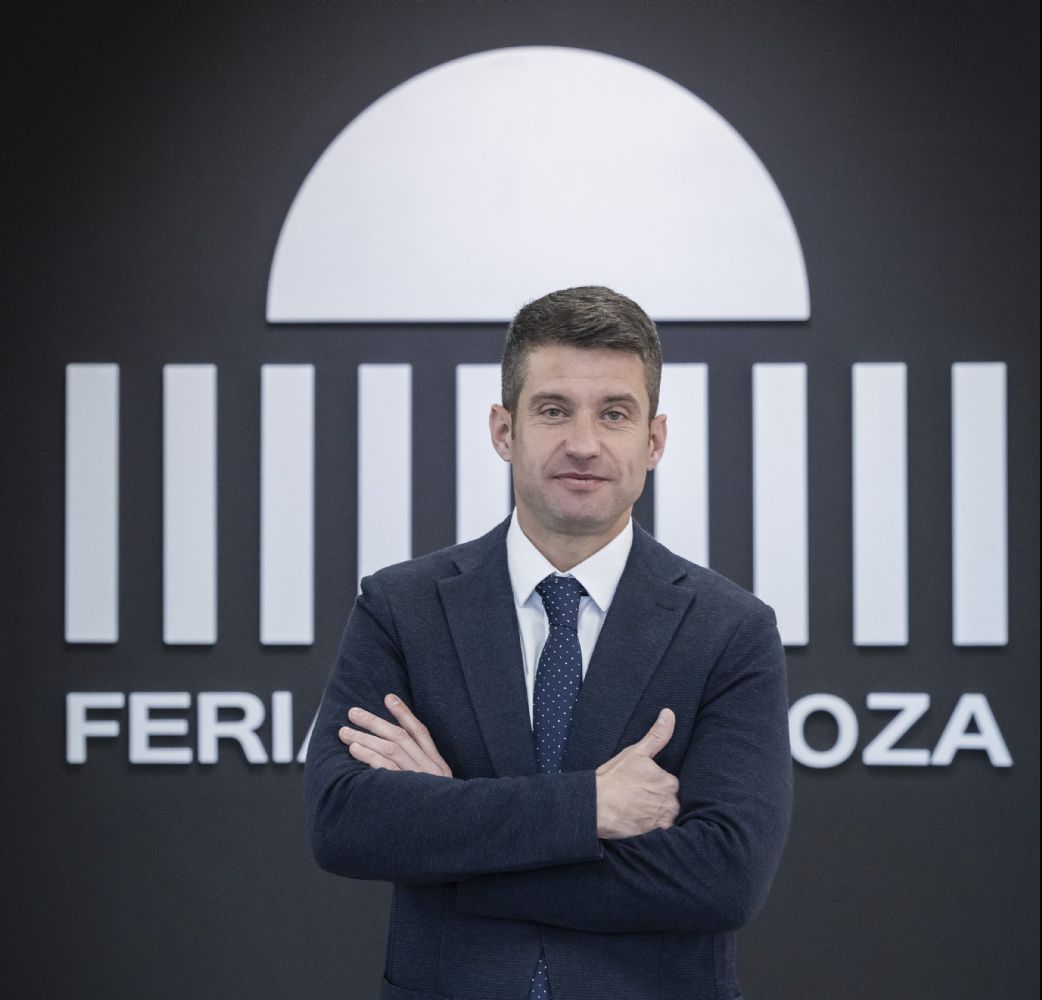
Fernando Cidraque. Director of the Agri-Food Area at Feria de Zaragoza
What motivated Feria de Zaragoza to support this congress as a sponsor, and what strategic value does it have for you?
For Feria de Zaragoza, supporting initiatives such as the Olive Oil World Congress fully aligns with our strategic vision and with the current moment the sector is experiencing. We have recently driven a new stage in ENOMAQ, marked by a deep rebranding that responds precisely to the need to integrate, connect, and provide a more cross-cutting vision of the entire beverage and liquid food industry.
Olive oil, and everything surrounding it—from olive growing to olive oil technology—is an essential part of the ENOMAQ ecosystem. Supporting this congress as sponsors is a natural way to reinforce our commitment to the sector, accompany its evolution, and help create spaces where knowledge, innovation, and business opportunities can be shared at an international level.
What makes the Olive Oil World Congress different from other agro-food sector events internationally?
This congress has a very clear distinctive element: its global vocation from a territory, the Iberian Peninsula, which is precisely the heart of world olive oil production. A very significant share of global production and sector knowledge is concentrated here, making the congress a particularly relevant meeting point.
Moreover, it is not limited to an exhibition-focused approach, but rather promotes debate, knowledge transfer, and connection across all links of the value chain. This more strategic and international approach is what truly positions it as a benchmark event.
From your perspective, what are the main challenges currently facing the olive oil sector, and how can a congress like this help address them?
The sector faces several key challenges. On one hand, there is the need to optimise agricultural production, moving towards more efficient and profitable cultivation models. In this context, intensive and super-intensive systems have proven their economic viability under certain conditions, thanks to their high level of mechanisation and productivity.
On the other hand, there is the challenge of continuing to revalue the product, positioning olive oil as a high value-added food, linked to quality, health, and origin.
A congress like this is essential because it allows the sharing of experiences, innovation, and best practices. And this is also where initiatives such as ENOMAQ play a key role, bringing technological solutions closer and creating an ecosystem where the entire sector can move forward together.
What key trends such as innovation, sustainability, or openness to new markets will shape the future of olive oil in the coming years?
Innovation and sustainability clearly go hand in hand. End consumers are increasingly demanding and value aspects such as environmental impact and responsible production processes.
At the same time, we are seeing a very interesting opening towards new markets that historically were not major consumers, while traditional markets continue to grow at a strong pace.
This requires the sector to adapt, to innovate in processes, in products, and also in the way it communicates, in order to remain globally competitive.
Based on Feria de Zaragoza’s experience in organising major agro-industrial events such as ENOMAQ, do you think the olive oil sector is going through a similar stage of evolution and international projection?
Without a doubt, the sector is facing a very promising future. Consumers increasingly value olive oil not only as a gastronomic product, but also as a fundamental pillar of a healthy diet—an aspect that is gaining increasing importance and awareness among consumers.
At the same time, the industry is making significant progress in quality, efficiency, and technology. This combination of growing demand and improved production capacity places the sector in a moment very similar to that experienced by other industries such as wine, with a clear international projection.
What real impact do you expect this congress to generate, both for attending professionals and for the global positioning of olive oil?
The impact will be twofold. On one hand, for professionals, the congress is an opportunity to update knowledge, build connections, and identify new business opportunities.
On the other hand, from a global perspective, holding the congress in the Iberian Peninsula reinforces the positioning of olive oil as a strategic product at the international level and highlights the leadership of our regions in this field.
These types of events help consolidate an image of a sector that is innovative, competitive, and prepared to face future challenges, in line with the evolution we are also promoting from Feria de Zaragoza with the new ENOMAQ.
 Sentido Común Internet
 Agrifood Comunicación

 Only available by accessing from Safari
