
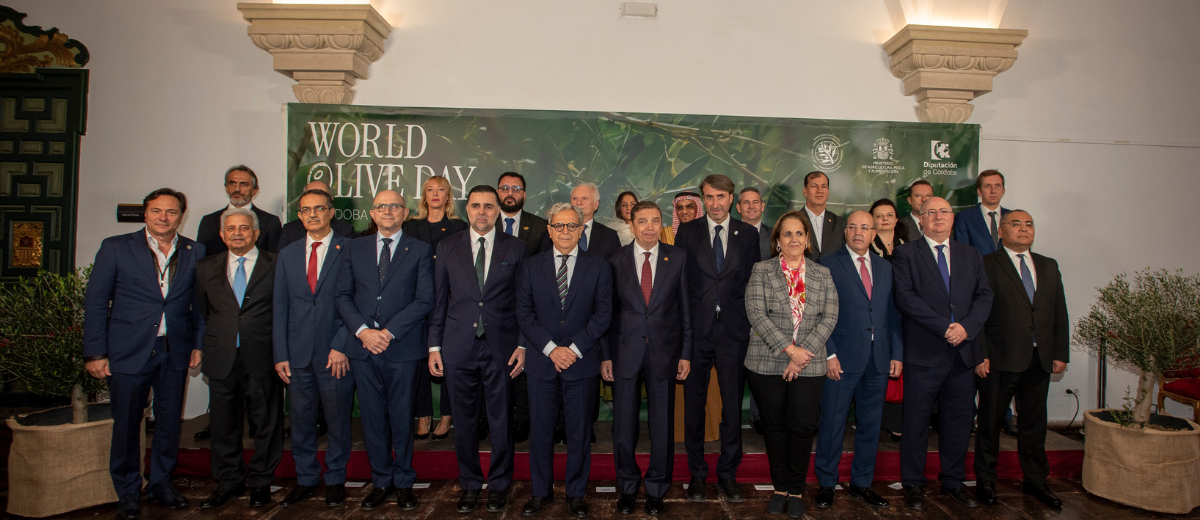
On World Olive Day, 28 olive oil and table olive–producing and exporting countries, along with two international organizations, discussed the opportunities and challenges facing the sector. During this meeting, the delegations also endorsed the Córdoba Declaration, a document promoted by the Ministry of Agriculture, Fisheries and Food and the International Olive Council (IOC). It sets out shared principles and priorities in the areas of sustainability, health, trade, and international cooperation.
The meeting, held at the Palacio de la Merced with the support of the Provincial Council of Córdoba, was chaired by the Minister of Agriculture, Fisheries and Food, Luis Planas; the Executive Director of the International Olive Council, Jaime Lillo; and the President of the Provincial Council of Córdoba, Salvador Fuentes. Ministers of agriculture and trade, diplomatic representatives, and officials from international organizations such as the European Commission and the International Centre for Advanced Mediterranean Agronomic Studies (CIHEAM) took part.
Minister Luis Planas stressed that today the olive oil sector is a model of international cooperation built on multilateral relations, friendship, and trust, aimed at ensuring the quality of olive oils and facilitating international trade of a product essential to the Mediterranean diet. He emphasized the need to intensify technical cooperation among participating countries to advance in a coordinated and transparent way, with guarantees that meet the expectations of the sector and the demands of consumers.
The Olive Tree as a Global Pact
Jaime Lillo, Executive Director of the IOC, highlighted that quality and trust are key to the continued expansion of olive cultivation across five continents. “Promoting a common regulatory framework not only facilitates international trade but also protects consumer rights. This is a task that the International Olive Council will continue to undertake with scientific rigor, fostering dialogue, technical cooperation, and innovation.”
The Declaration also recognizes the environmental role of olive groves and supports scientific studies and practices that maximize their ability to absorb and store CO₂, contributing to climate change mitigation. Currently, olive groves cover more than eleven million hectares of cultivated forest, capable of absorbing around 4.5 tons of CO₂ per hectare per year.
In addition, more than 1,000 scientific studies show that regular consumption of extra virgin olive oil reduces the risk of cardiovascular, metabolic, and neurodegenerative diseases. Clinical trials such as PREDIMED confirm that a Mediterranean diet enriched with this oil reduces the incidence of heart disease by 30%. Therefore, integrating olive oil into public health strategies is another key point of the Declaration.
Finally, ministers and representatives agreed on the importance of strengthening collaboration with chefs, restaurateurs, and hospitality schools to promote consumer education about olive oil and table olives. Future actions will focus on disseminating quality standards, varietal diversity and origins, as well as nutritional properties, flavor profiles, and culinary uses—promoting a gastronomic culture grounded in knowledge and excellence.
The President of the Provincial Council, Salvador Fuentes, welcomed all participants and noted that the region “is becoming the epicenter of global debate, establishing its strategic position worldwide through the Córdoba Declaration.”
“With this event, we recognize the effort, the work, the legacy, and the living memory of olive-growing communities across the world, which are essential for territorial development and for ensuring biodiversity and sustainability on a global scale,” Fuentes added.
Córdoba: Global Epicenter of Olive Cultivation
With a centuries-old olive-growing tradition, Córdoba has consolidated its position as the global epicenter of oliviculture by hosting the 122nd plenary session of the IOC’s Council of Members, held yesterday, along with the ministers’ meeting.
During the current agricultural year, Córdoba’s 187 mills—Spain’s second-largest producing province after Jaén—produced 291,032 tons of olive oil. These figures reflect not only the sector’s economic importance in the region but also its strategic contribution to the olive value chain.
 Sentido Común Internet
 Agrifood Comunicación

 Only available by accessing from Safari
