
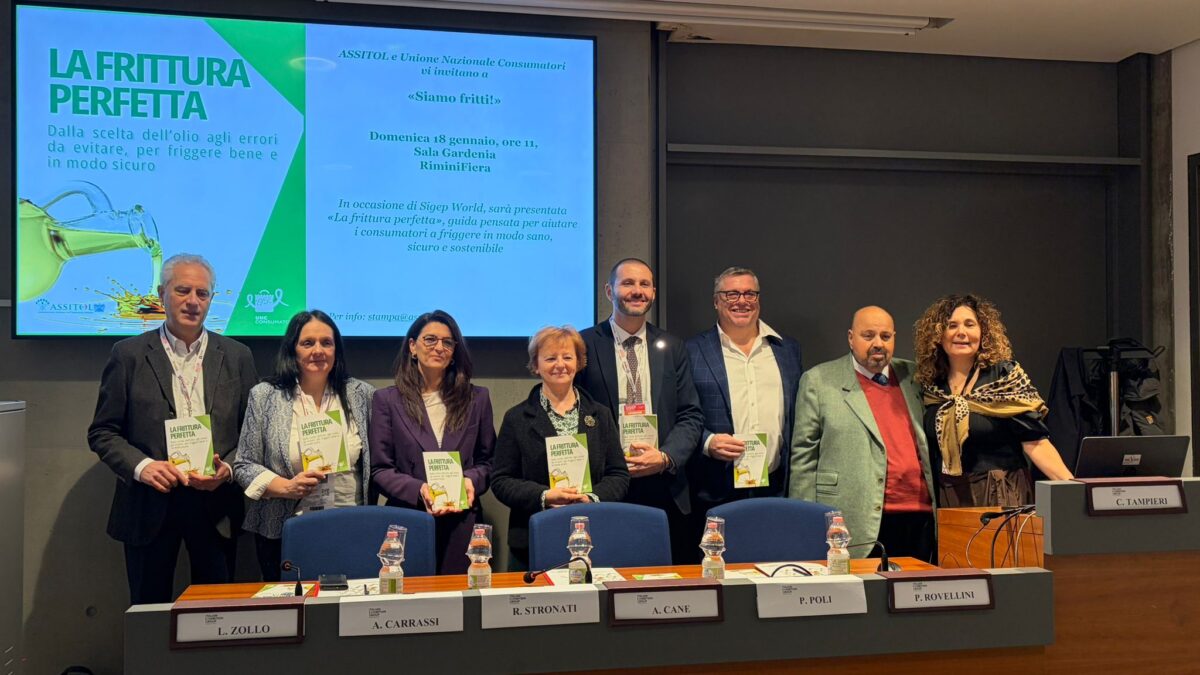
ASSITOL and the National Consumers’ Union have launched an online downloadable leaflet to provide consumers with accurate information about frying, debunking many common misconceptions.
The goal is to guide consumers and offer reliable information on frying, one of the most beloved cooking methods in Italian cuisine. With this aim, ASSITOL—the Italian Association of the Olive Oil Industry—and the National Consumers’ Union created The Perfect Frying, a guide designed to promote healthy, safe, and sustainable consumption of fried foods.
The guide, available for download from the two associations’ websites, was presented at Sigep, the International Trade Fair for Artisan Bakery, Pizza, Gelato, Pastry, and Coffee, which concluded a few days ago in Rimini.
This is not the first collaboration between ASSITOL and the National Consumers’ Union. “We started in 2017,” recalled Livia Zollo, Vice President of the UNC. “Today’s collaboration represents an evolution, driven by the need to provide accurate information about food at a time when fake news is proliferating. Fried foods—loved by many and feared by others—are the ideal topic to convey the right messages to consumers, promoting food safety and sustainability.” The concise leaflet will also be the focus of a social media campaign.
Frying is an integral part of Italy’s culinary culture, emphasized Andrea Carrassi, Director General of ASSITOL. “This iconic Italian preparation has countless regional variations and is associated with celebrations such as Christmas and Carnival. With this initiative, we clearly state that frying should not be demonized, as some food fundamentalists claim, but rather prepared according to precise rules. Understanding how this cooking process works means enjoying fried foods fully and safely.”
So how do you achieve perfect frying? The guide offers precise—but far from obvious—recommendations. First, it is best to maintain a stable temperature, starting at 160 °C and ideally not exceeding 180 °C. The smoke point— which varies by oil—must not be exceeded; it is the temperature at which heated fats begin to degrade, releasing unpleasant odors and substances harmful to health. Foods should be fried completely dry, as water alters the oil’s composition; cooking should be quick. Finally, it is essential to drain foods on paper towels, without covering them. To promote a crispy texture, a brief chilling period of 15–20 minutes before frying is recommended. Topping up or reusing previously used oil is strictly prohibited, and salt should be added only at the end of frying.
Disposal also matters: used oil is a special, non-biodegradable waste. Never pour it down the sink. Let it cool, transfer it to a container, and take it to a designated collection point (recycling centers or specific containers). Used oil is recovered for the production of biofuels, in line with environmental protection and the principles of the circular economy.
Beyond technique, the choice of oil is crucial and depends on consumption habits, consumer budget, and the type of frying (home or industrial). There is no single “best” oil for all purposes. The market offers a wide range—from traditional extra virgin olive oil to the increasingly popular high-oleic sunflower oil, as well as frying oils formulated for high temperatures. Frying oils must be stable and able to withstand high heat. In this regard, the smoke point is helpful but not the only criterion.
A common misconception addressed by the guide is that extra virgin olive oil is too “noble” for frying. Anna Cane, President of ASSITOL’s Olive Oil Group, explained: “Extra virgin olive oil, a key ingredient in Italian cuisine, is indispensable. Its high antioxidant content also makes it suitable for frying. The real issue, if any, is that its complex aroma can influence the final result, giving fried foods a flavor different from the original. Nevertheless, its nutritional and health value remains important in certain recipes; for example, it preserves the omega-3 fatty acids in fish, even when fried.”
For Carlo Tampieri, President of ASSITOL’s Seed Oils Group, the role of oil producers is fundamental. “The quality and sustainability of the final product are based on upstream decisions—from raw material selection to production processes—and continue with the oil through to its culinary use.” The most widely used seed oil for frying is high-oleic sunflower oil, thanks to its monounsaturated fat–rich composition, similar to that of olive oil. “This shows that frying is not just a matter of taste, but of knowledge, responsibility, and effort across the entire supply chain.”
Ultimately, the best guarantee is the experience and know-how of both producers and users. This was emphasized by Raffaele Stronati, President of the Association’s Spreads and Condiments Group. “Frying—at home and in industrial settings such as pastry shops and bakeries—is not harmful, it bears repeating, as long as it is done properly. This type of cooking requires professional management, starting with careful oil selection. Italian companies are working hard in this area, aware that, depending on production needs, sustainable palm oil may be more efficient than sunflower oil. With this approach, consumers have nothing to fear.”
Frying is also safe thanks to Italian regulations and controls. Pierangela Rovellini, Head of the Chemistry, Technology, and Food Safety Team at Innovhub-SSI, addressed this point. “The Ministry of Health has long issued specific guidelines,” she explained, “which precisely define the controls and analyses to which oils and fats must be subjected.” This regulatory and scientific framework ensures safe, tested products for consumers. “At Innovhub, we verify hundreds of oils and fats for compliance with safety and health parameters every year. Overall, we can say that in Italy, most oils and fats for food use are carefully checked and analyzed before being placed on the market.” There are also consumption guidelines consumers should remember: “Fried food is delicious, but it is not something to be eaten every day. In particular, children should only begin eating fried foods after the age of two, preferably homemade.”
 Sentido Común Internet
 Agrifood Comunicación

 Solo disponible accediendo desde Safari
