
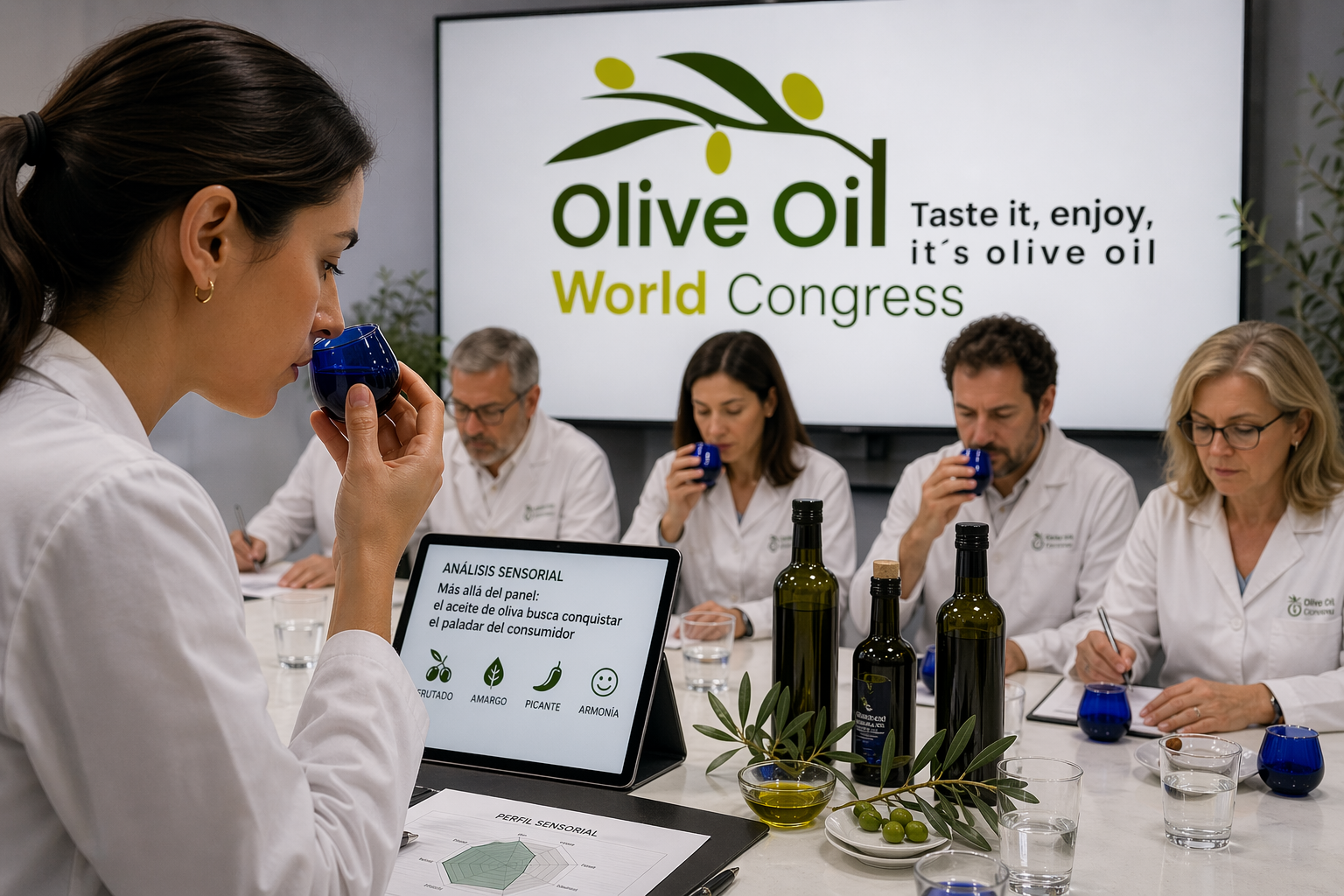
For decades, the quality of extra virgin olive oil has been defined in highly controlled environments, where panels of trained experts apply rigorous methodologies to evaluate sensory attributes with scientific precision. However, in an increasingly global, competitive, and consumer-oriented market, this model is beginning to evolve. The Olive Oil World Congress (OOWC), to be held on July 2 and 3, 2026, at the Belém Cultural Center in Lisbon, becomes the stage where this transformation takes shape: sensory analysis is no longer confined to the laboratory but extends to the consumer’s palate.
The session dedicated to the latest advances in sensory analysis brings together leading international specialists in the roundtable “Latest advances in VOO sensory analysis.” Participants include Plácido Pascual, head of the Virgin Olive Oil Tasting Panel at the Agro-Food Laboratory of Córdoba (Spain); Susana Mattar from the Catholic University of Cuyo (Argentina); Ana Carrilho from the University of Lisbon (Portugal); Efi Christopoulou, head of the official panel in Greece; and Tullia Gallina Toschi from the University of Bologna (Italy). This diverse forum brings together different production, scientific, and regulatory perspectives, offering a global view of the challenges and opportunities in sensory analysis.
Throughout the session, participants will address how traditional methodologies are continually being reviewed to adapt to an environment where consumer perception carries increasing weight. The need to maintain objective standards now coexists with the urgency of interpreting consumption trends, cultural preferences, and market expectations, requiring a rethinking of evaluation tools.
In this context, Plácido Pascual will present the talk “Training of VOO tasting panels and harmonisation,” focusing on one of the system’s pillars: the training and harmonization of tasting panels. His presentation underscores the importance of ensuring consistency among panels at the international level, a key factor in preserving the credibility of sensory analysis as a regulatory and quality control tool.
But the session goes a step further. Susana Mattar, in her presentation “From expert panel to hedonistic tasting: sensory properties and quality of EVOO,” introduces a complementary dimension: the consumer. Her proposal suggests integrating hedonic methodologies that allow measurement not only of what an oil is from a technical standpoint, but also what it represents to the person consuming it. This shift in approach directly connects with the purchasing experience and product positioning in the market.
This dialogue between scientific precision and subjective perception reflects a profound transformation in the olive oil sector. Sensory analysis is no longer a closed system but becomes a shared language among experts, producers, and consumers. In this new paradigm, quality is defined not only by the absence of defects or the presence of positive attributes, but also by an oil’s ability to generate preference, emotion, and loyalty.
The Olive Oil World Congress thus consolidates its role as a leading international platform for anticipating the trends that will shape the future of extra virgin olive oil. At the intersection of laboratory and market, the message is clear: understanding the consumer is no longer an option but an essential condition for defining the quality of tomorrow.
All individuals, companies, or public and private institutions in the olive oil sector interested in participating in this Congress can register via the following link: https://www.oliveoilworldcongress.com/inscripcion
The Congress already has institutional backing from the International Olive Council (IOC), CIHEAM, and the Mediterranean Diet Foundation, along with public entities such as the Ministry of Agriculture, Fisheries and Food of Spain (Alimentos de España), the Ministry of Agriculture and the Sea of Portugal, the Regional Government of Castilla-La Mancha (“Campo y Alma”), the Government of Catalonia, and IMIDRA.
In the private sector, this second edition is currently supported, in addition to Olivum, by entities such as AgroBank, GEA Group, Kubota, Feria de Zaragoza (ENOMAQ), Dazeite, and Siliker.
From the OOWC, we invite everyone to be part of this collaborative international project, encouraging them to explore cooperation and sponsorship opportunities, and providing all necessary information through the OOWC Technical Secretariat by calling +34 91 721 79 29 or emailing info@oliveoilwc.com.
 Sentido Común Internet
 Agrifood Comunicación

 Only available by accessing from Safari
