
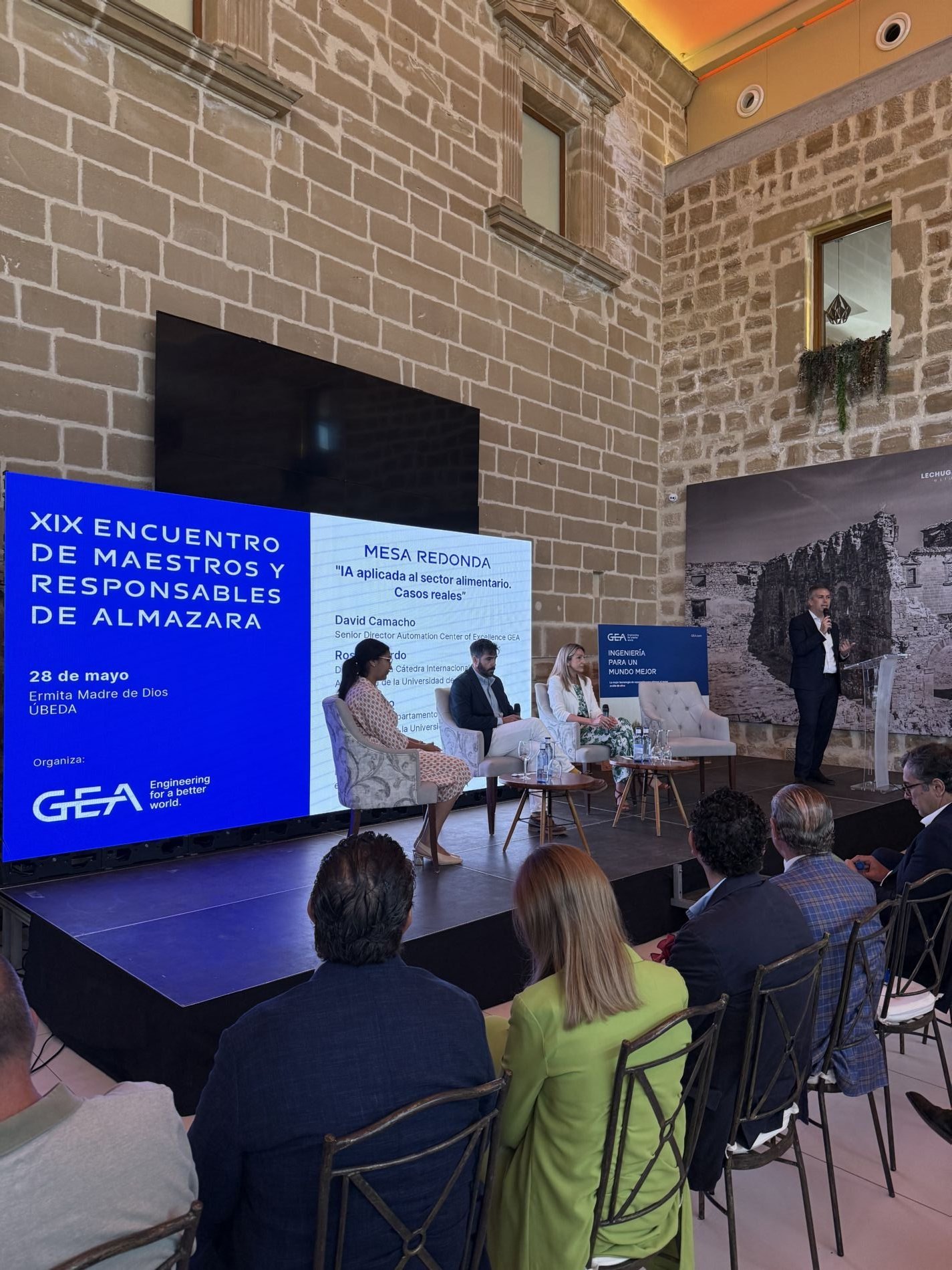
The technological transformation of the olive oil sector continues to consolidate itself as one of the major strategic challenges in ensuring the competitiveness and sustainability of the olive oil industry. Issues such as automation, artificial intelligence (AI), digitalization, and industrial efficiency were at the center of discussions during the 19th Meeting of GEA Olive Mill Masters and Managers, held in Úbeda (Jaén), and will once again play a leading role at the upcoming Olive Oil World Congress (OOWC), which has officially begun its countdown to the event taking place on July 2–3 at the Belém Cultural Center in Lisbon.
GEA, a leading technology provider for the olive oil industry and sponsor of the OOWC, brought together researchers, industry professionals, and institutional representatives, all of whom agreed on the need to accelerate the modernization of a sector facing a decisive period marked by production, energy, and commercial challenges.
The event was also attended by Ricardo Miguelañez, General Coordinator of the Olive Oil World Congress, who highlighted the importance of knowledge, innovation, and the exchange of experiences in addressing the major challenges currently facing the olive oil sector. In this regard, he stressed that “uncertainty can be tackled through technology, information, and shared knowledge among all stakeholders in the value chain,” emphasizing the value of events such as the one organized by GEA in driving the transformation of the industry and anticipating the challenges of the international market.
Much of this strategic line of analysis and debate will continue within the OOWC program in Lisbon. The international congress will explore the future of olive mills in the round table discussion entitled “The Olive Mill of the Future: Automation, Energy Efficiency and Circularity,” featuring Antonio López (GEA Group), reinforcing the Olive Oil World Congress’s commitment to making innovation and sustainability two of the main pillars of the global olive oil market.
This section will also include the presentation “Digitalization of Agri-Food Value Chains: Opportunities, Challenges, and Value Creation,” delivered by Chiara Corbo (Polytechnic University of Milan), focusing on the opportunities and challenges posed by new technologies within the agri-food chain and how innovation can strengthen the sector’s competitiveness in international markets.
All individuals, companies, and public or private institutions within the olive oil sector interested in participating in this Congress may complete their registration through the following link: https://www.oliveoilworldcongress.com/inscription
The Congress has already secured the institutional support of the International Olive Council (IOC), CIHEAM Zaragoza, and the Mediterranean Diet Foundation, together with public entities such as the Portuguese Ministry of Agriculture and Maritime Affairs, the Regional Government of Castilla-La Mancha (“Campo y Alma”), the Government of Catalonia, and IMIDRA.
On the private side, this second edition is currently supported, in addition to Olivum, by entities such as AgroBank, the Spanish Olive Oil Interprofessional Organization, GEA Group, Novonesis-Univar Solutions, APOAC (Association for the Promotion of Olive Groves and Olive Oil of Aire e Candeeiros) with its commercial brand “Olivedos do Carso,” Adsaica (Association for the Development of the Aire e Candeeiros Mountains), Feria de Zaragoza (ENOMAQ), Kubota, Dazeite, and Siliker.
The OOWC invites everyone to become part of this collaborative international project, encouraging stakeholders to explore cooperation and sponsorship opportunities, while making all necessary information available through the OOWC Technical Secretariat by calling +34 91 721 79 29 or emailing info@oliveoilwc.com.
 Sentido Común Internet
 Agrifood Comunicación

 Solo disponible accediendo desde Safari
