
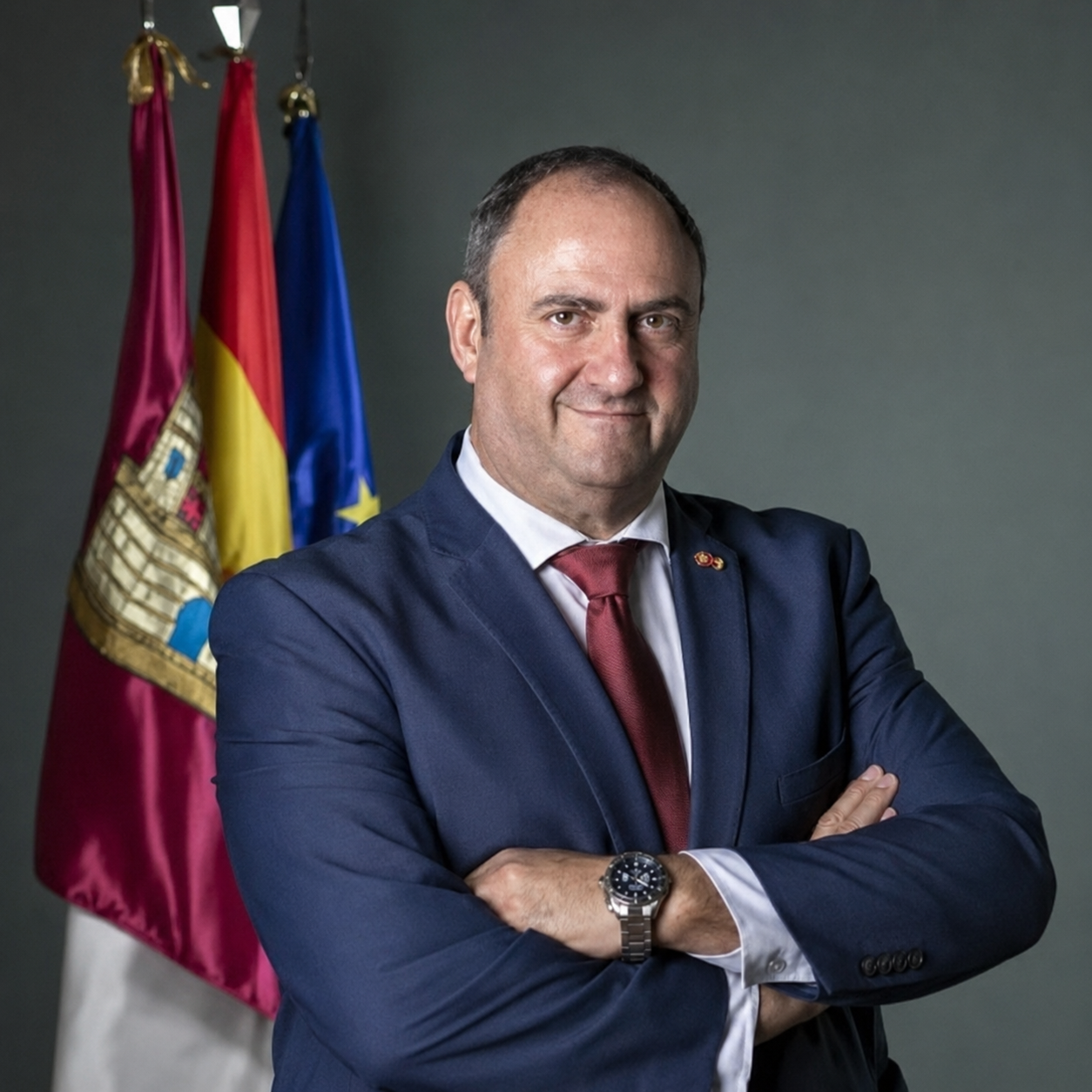
Julián Martínez Lizán. Regional Minister for Agriculture, Livestock and Rural Development of Castilla-La Mancha
Castilla-La Mancha has established itself as one of the world's leading olive-growing regions, but the sector is currently facing turbulent times: drought, rising costs, market pressures, and changing consumption patterns. What genuinely concerns you when you think about the future of olive groves in Castilla-La Mancha over the next ten or fifteen years?
I am concerned that we may not be able to address, in a comprehensive way, the various challenges that lie ahead. Among the most significant are those related to climate conditions, such as abrupt temperature changes within just a few days, shifting from summer-like to winter-like weather, prolonged droughts, increasingly intense storms, and all the consequences associated with climate change.
I am also concerned about marketing challenges and, of course, the profitability of farms at a time when production costs can change rapidly due to geopolitical factors such as wars and tariffs. We must ensure that olive growers, like producers in other sectors, receive a fair price for their products. At the same time, it is clear that we must continue advancing modernization and innovation, not only to improve yields but also to reduce production costs.
In my view, these are the main issues, and they are all interconnected. Technology, innovation, and artificial intelligence, for example, can help us develop crops that are more resilient to drought, predict harvest outcomes, optimize production based on data, monitor olive grove health in real time, and automate cultivation and harvesting processes.
Moreover, AI is advancing at an extraordinary pace, so we must remain attentive and ready to implement these tools. To achieve this, collaboration between public administrations, businesses, and research centers is essential.
We must also continue making progress in marketing. Spain is already present in more than 150 countries, but we need to defend our position in strategic markets such as the United States while simultaneously opening new opportunities in Mercosur countries, South Korea, Canada, Japan, and, of course, within the European Union. In this regard, our greatest asset is the outstanding quality of our olive oils.
You often speak of olive oil not only as an economic product but also as part of territorial identity. In many towns across Castilla-La Mancha, olive growing continues to shape everyday life. How can this human and cultural dimension of olive oil be protected at a time when everything seems to push toward industrialization and short-term profitability?
Indeed, olive oil is not only one of the cornerstone foods of the Mediterranean diet, but it is also deeply linked to a way of life and a gastronomic culture supported by a rich cultural heritage.
For that reason, I believe the best way to protect this dimension is, as I mentioned earlier, by protecting producers first and foremost, as they are at the foundation of the sector and often its most vulnerable component. Olive growers must receive fair prices for a product whose nutritional and health benefits, including the prevention of cardiovascular diseases, have been widely demonstrated.
We must also protect the entire ecosystem of mills, cooperatives, and industries that transform olives into olive oil.
And, of course, we need to highlight the value of this entire system so that the public and consumers understand and appreciate it.
Recently, the regional government strengthened its commitment to agri-food modernization through new FOCAL support schemes and assistance for cooperatives and olive mills to continue transforming the sector. In your opinion, what is the major pending revolution for olive oil in Castilla-La Mancha today: technology, marketing, or learning how to communicate the value of the product more effectively?
In my opinion, all three issues are essential.
We must continue innovating and incorporating technologies that allow us to tackle major challenges such as those brought about by climate change, particularly those related to water management in certain areas of our region.
In terms of marketing, we have made enormous progress. First, by producing high-quality olive oils, supported in our region by four Protected Designations of Origin. Now we must continue along this path by bringing excellent products to market, supported by attractive visual identities and by effectively communicating their outstanding qualities.
Whenever I speak about olive oil, I often point out that in some countries it is recommended almost as a medicine. This is an area where we must continue to emphasize the extraordinary properties of this product.
Therefore, we must keep working to ensure that global olive oil consumption, which has steadily increased over recent decades, continues to follow this positive trend.
In recent months, Castilla-La Mancha has also highlighted the strategic importance of the agri-food sector and initiatives such as the “Campo y Alma” brand to position high-quality products internationally. Do you believe that Spanish olive oil has still not fully succeeded in telling its story abroad?
Spanish olive oil is one of the flagship products of Spanish agriculture and food production. It carries immense cultural significance and possesses unparalleled qualities as a food product.
In my opinion, it is increasingly recognized beyond our borders—as I mentioned, we are already present in more than 150 countries—thanks to its exceptional quality, certified by 33 Protected Designations of Origin and Protected Geographical Indications across twelve autonomous regions, including Castilla-La Mancha, which contributes four PDOs. We are also fortunate to have unique varieties such as Cornicabra.
Nevertheless, we must continue creating greater added value in order to consolidate Spanish olive oil as a global benchmark. Perhaps the challenge is not to produce more, but rather to ensure that our product receives the value and price it truly deserves.
The Olive Oil World Congress has a global vocation, but it also aims to connect tradition, innovation, and olive oil culture. What message would you like someone visiting from outside Spain to take away from the congress when discovering, for the first time, what olive growing represents in Castilla-La Mancha?
I would like visitors to leave with three or four clear ideas.
First, that we are a benchmark in olive oil production not only in Spain but also at the European level. With 460,000 hectares of olive groves, we are the world's third-largest olive oil-producing region.
Second, that we are a benchmark for quality. Our oils speak for themselves, and we are proud to have four Protected Designations of Origin, all under our regional quality label, Campo y Alma.
Finally, olive growing is particularly important in our region because it is a social crop. It provides economic support to many families, contributes to the preservation of landscapes and rural territories, and plays an important role in combating climate change.
 Sentido Común Internet
 Agrifood Comunicación

 Only available by accessing from Safari
